

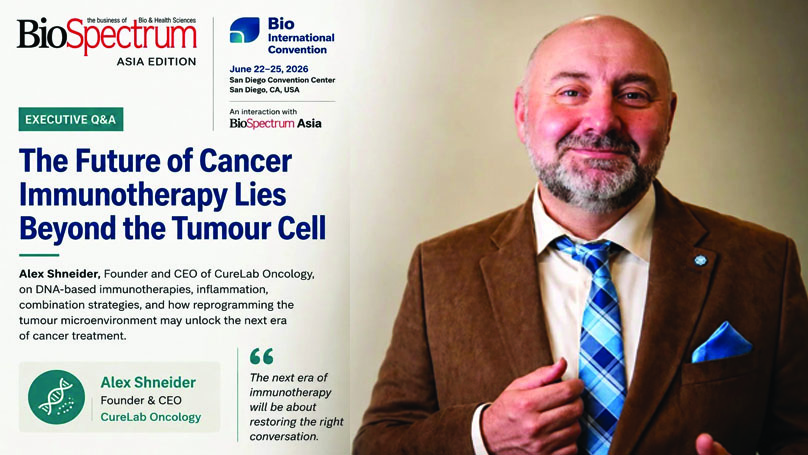
Cancer immunotherapy is entering a new phase—one that extends beyond targeting individual tumour cells and towards reshaping the biological systems that enable cancer to survive and evolve. Advances in DNA-based therapeutics, tumour microenvironment engineering, chronic inflammation research, and personalised neoantigen medicine are opening new avenues for treatment design. In this conversation with BioSpectrum Asia during BIO International Convention 2026, Alex Shneider, Founder and CEO of CureLab Oncology, shares his perspectives on the next generation of cancer immunotherapies, the growing importance of rational combination strategies, and why the future may lie in restoring healthy cellular communication rather than simply blocking disease pathways.
How could DNA-based immunotherapies reshape the next generation of cancer treatment strategies?
It is impossible to predict every future trajectory, but the pillars of the next generation of medicine are already taking shape.
Intracellular delivery and personalized neoantigen medicine. In the early days of genetic medicine, DNA and RNA therapies were deployed simply to encode cancer-associated antigens — a strategy that remains fundamentally powerful. An antigen expressed natively inside a patient's own cells undergoes the precise post-translational modifications, conformational assembly, and immune presentation required to drive robust, dual B-cell and T-cell immunity. This stands in sharp contrast to traditional recombinant proteins, which elicit a predominantly antibody-restricted response. Deep sequencing has since opened the era of personalized neoantigen medicine — a frontier that, in my view, is most realistically navigated via DNA/RNA technology. Early in my career, my colleagues and I focused not merely on selecting the optimal target, but on strengthening the host's immune response to the encoding DNA itself — leveraging antigen aggregation, controlled proteasomal processing, and heterologous prime-boost regimens. I expect these threads to converge: highly personalized neoantigens paired with molecular machinery that systematically amplifies the immune response against them.
From static dosing to smart, dynamic constructs. A second direction is the use of plasmids and vectors to deliver localized immunostimulatory molecules, such as plasmids driving IL-12 or complementary cytokines. Looking further ahead, I believe the future belongs to genuinely dynamic constructs: vectors that do not merely express immune stimulators or silence immunosuppressive pathways at a fixed level, but modulate that expression in response to the changing homeostatic state of the host or the evolving tumor microenvironment. This is the shift from therapies that blindly execute a script to therapies that sense, adapt, and respond.
Remodeling the asymmetric tumor microenvironment. Third, we are seeing a meaningful shift toward using DNA/RNA vectors to remodel the tumor microenvironment itself — attacking the malignant cells directly while simultaneously stripping the tumor of its protective, immunosuppressive shield to render it susceptible to companion therapies. This work will benefit enormously from our rapidly advancing ability to map spatial transcriptomics. Tumors are highly structured, asymmetric, and compartmentalized ecosystems rather than uniform cellular masses, and our therapies must be engineered to disrupt that specific spatial defense.
These dimensions are not mutually exclusive; the most effective agents will likely combine several of these mechanisms within a single vehicle. This philosophy of deliberate convergence is the thesis behind our own platform, Elenagen, which brings several of these synergistic mechanisms into a single, multi-targeted DNA-plasmid design — aiming not just to attack a single pathway, but to alter the broader landscape of the tumor.
What role does chronic inflammation play in tumour progression, and why has it become an increasingly important therapeutic target?
Chronic inflammation is now understood not as a bystander to cancer but as an active enabler of it. Smoldering, unresolved inflammation contributes at every stage. Early on, reactive oxygen and nitrogen species from inflammatory cells cause DNA damage and genomic instability. As a tumor grows, inflammatory signaling — through pathways such as NF-κB and IL-6/STAT3 — drives proliferation, blocks programmed cell death, promotes new blood-vessel formation, and supports invasion and metastasis.
It has become such an important target because of its central role in two of oncology's hardest problems: immune evasion and treatment resistance. Chronic inflammation recruits immunosuppressive cells — myeloid-derived suppressor cells, regulatory T cells, and pro-tumor macrophages — that switch off the cytotoxic T cells which would otherwise destroy the tumor. The result is the "cold" tumor that does not respond to checkpoint inhibitors. The same signaling confers resistance to chemotherapy by activating cell-survival programs. And systemically, chronic inflammation drives cachexia, erodes performance status, and predicts worse outcomes — which is why markers such as C-reactive protein and the neutrophil-to-lymphocyte ratio track with prognosis.
The therapeutic art lies in a distinction that is easy to miss: we want to promote productive, acute anti-tumor immunity while damping the chronic, immunosuppressive inflammation that protects the tumor. These are biologically distinct, and the goal is to convert one into the other — to turn cold tumors hot — rather than to suppress immunity wholesale.
This is the thesis behind our own program. In a randomized Phase II trial in platinum-resistant ovarian cancer, adding our inflammation-modulating plasmid to chemotherapy more than doubled median overall survival, with zero treatment-related serious adverse events. We have also seen the anti-inflammatory mechanism produce a published efficacy and safety signal beyond oncology — in a peer-reviewed study of chronic, inflammation-driven pain — while preclinical work on the p62 target has shown reductions in neuronal inflammatory processes. Together, these reinforce a broader point: controlling the inflammatory context is emerging as a foundation on which other therapies work better. The field still needs better biomarkers and deeper mechanistic understanding, but the direction of travel is clear.
How do you see combination therapies evolving within the immuno-oncology landscape?
To my mind, this is one of the central questions—and one of the primary hurdles—in modern oncology. Cancer is an extraordinarily complex, evolving biological phenomenon. Just as no conventional war has ever been won with a single type of weapon, however refined, I do not believe the war on malignancy can be won with monotherapy. The future is indisputably combinatorial.
Overcoming institutional and corporate inertia: For decades, combination therapy ran against two powerful human forces: the ego of the inventor, who sought exclusive credit for a breakthrough, and the commercial instinct of the corporation, which sought unshared revenue. The encouraging news is that this protective era is ending. The industry has finally come to understand that it is far better to win together than to lose alone—and that collective realization may shift clinical outcomes as much as any single blockbuster molecule.
The mathematical impossibility of brute force: The core operational difficulty is that we cannot simply test every combination blindly; the mathematics strictly forbids it. Five candidate agents yield more than 30 possible combinations; 10 yield over 1,000; 20 yield more than a million; and 30 yield over a billion. This is even before accounting for variables like dosing, scheduling sequence, and timing. Because a linear increase in therapeutic components produces an explosive, exponential increase in combinations, brute-force empiricism is a statistical dead end. The real mandate of the next decade is rational, biology-guided selection.