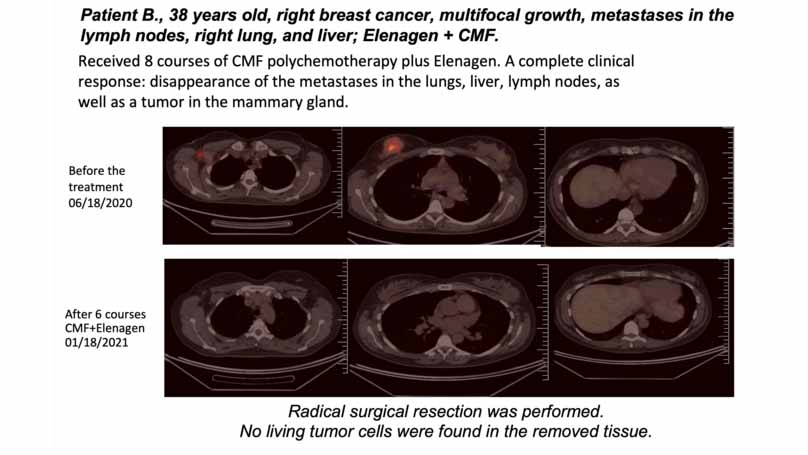
BOSTON, February 22, 2024: CureLab Oncology, a clinical-stage, pre-IPO biotech company, announced that its novel biological agent, Elenagen, has been shown to significantly enhance standard chemotherapy and provides clinical benefits for the patients with the deadliest form ovarian cancer. Elenagen belongs to a novel class of biological agents, supercoiled circular DNA (plasmids).
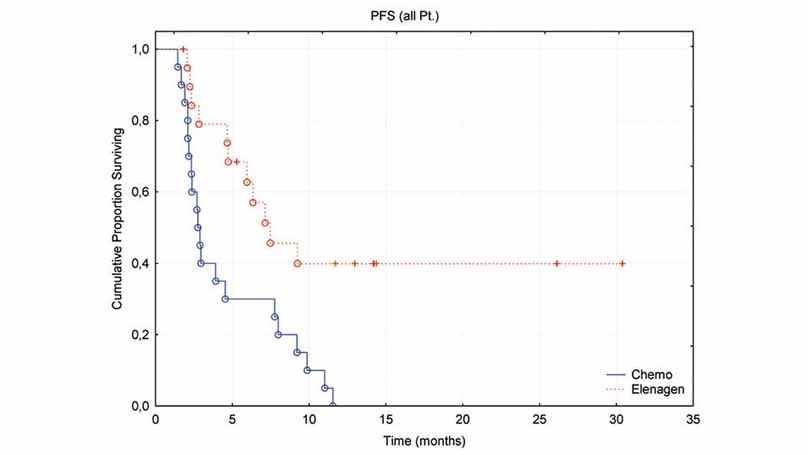
The study, published in Frontiers in Oncology, shows that disease progression was significantly delayed in a group of stage III and IV platinum-resistant ovarian cancer (PROC) patients who received gemcitabine in combination with Elenagen, compared to the group who received gemcitabine alone.
Almost 1 in 80 women will be diagnosed with ovarian cancer during their lifetime. Today, the majority of newly diagnosed ovarian cancer patients are initially treated with platinum-based chemotherapy (such as cisplatin and carboplatin), a therapy that halts disease progression over a prolonged period. Sooner or later, however, most patients stop responding to platinum therapies, joining those who had a platinum-resistant form of ovarian cancer from the beginning.
Treatment options for these patients are limited, which makes it especially important to improve the efficacy of available non-platinum-based chemotherapies. The short lifespan of platinum-resistant ovarian cancer (PROC) patients is further exacerbated by their reduced life quality associated with disease progression.
Currently available chemotherapies provide only a short period of progression-free survival (PFS), during which time neither the primary tumor nor a metastatic process exacerbate the patient’s symptoms. Also, these therapies may cause toxic side effects. The search for non-toxic adjuvants that could extend PFS for PROC patients is a major medical need for oncology and women’s health because almost 1/110 women will die of PROC.
Gemcitabine is among the most-often prescribed PROC chemotherapies — and it’s an interesting example of how mechanism-based drug development is often failing as a model.
“Perhaps, gemcitabine is teaching us to be skeptical of the dominant biotech dogma,” said Dr. Alexander Shneider, the primary author of the paper and CureLab’s founder. “In 1971, when President Nixon declared a ‘war on cancer,’ scientists made an honest and probably inevitable mistake: they proposed that new drugs should come from a deeper understanding of the molecular mechanisms of the disease.
“Thus, it became ‘cool’ for top academic institutions and the most prestigious journals to pursue only mechanism-based drug development, undermining and ignoring the traditional way that brought us most of the life-saving drugs in use today. After five decades and hundreds of billions spent, relatively few drugs have made it to medical practice using the mechanism-based approach. Gemcitabine is a classic example of one of the pitfalls of mechanism-based drug development. What we consider the mechanism of action today may, tomorrow, turn out to be just one of the mechanisms — and maybe not even the most important one.”
The original purpose of gemcitabine was to mimic the nucleotides necessary to build DNA. Since cancer cells divide more rapidly than normal cells, they must build more DNA. Therefore, molecules that act as 'defective' nucleotides will cause greater damage to cancer cells that are rapidly dividing. Scientists were extremely proficient at measuring DNA replication and cell division at the time but were less effective at assessing different types of immune response.
Later, it was found that gemcitabine and some other chemotherapies have a crucial effect (if not a more important effect) on cancer patients’ immune system as they have on their ability to halt cell division. This is one of the typical situations analyzed by Shneider in his paper “Mental inertia in the biological sciences,” published in Trends in Biochemical Sciences, where he attempted to systemize and classify types of mental inertia common in science. Another paper published by Shneider in TIBS paper (“Four stages of a scientific discipline; four types of scientist”), was initially rejected by 12 journals and then held the #1 position as the most-read paper, according to Faculty 1000.
“I did not analyze mental inertia in science and evolution of scientific disciplines to publish papers,” said Shneider. “To me, publishing is not that important. In fact, this work liberated the CureLab team—and me—from dominant dogmas. In a way, one might say that the Elenagen journey is an exercise in overcoming mental inertia, which makes us somewhat outsiders to the mainstream.”
The first papers published by the team on Elenagen, however, did not promise to lead to anything contrarian. Rather, Shneider opted for a more typical therapeutic vaccine approach. Shneider explained: “The p62 protein is present in all cells. Cancer cells, however, cannot survive without it. Moreover, cancer cells overexpress p62, which protects them from chemo- and radiation therapy.